The First Move - Designing Success Before the Battle Begins
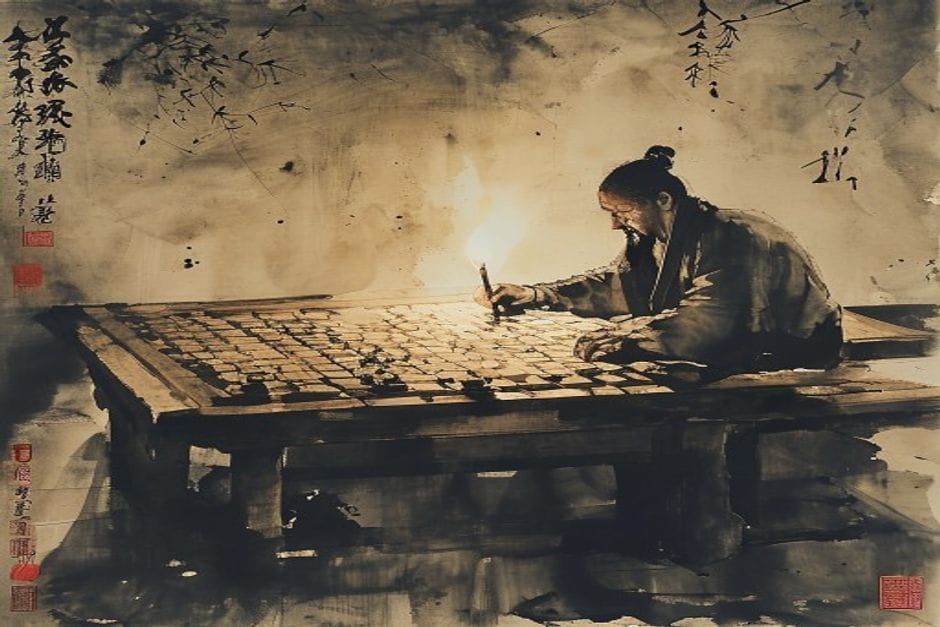
"The battles I have lost were never lost on the day of the fight — they were lost in the weeks before, when I was too busy moving to sit down and think."
Most people approach a new challenge the way a person approaches a cold swimming pool: hesitating at the edge, psyching themselves up, then finally jumping in and hoping the shock of the water won't be too bad. The strategy, if you can call it that, is to begin and figure things out as you go. There is something admirable about this — courage has real value, and motion is better than paralysis. But there is also something quietly costly about it. People who consistently achieve things they care about tend not to operate this way. They have usually already won, in some important sense, before they begin.
This is the heart of one of Sun Tzu's most counterintuitive ideas. 先勝而後求戰: first secure victory, then go to battle. Not as a description of inevitable triumph, but as a prescription for how to approach any meaningful endeavor. The general who fights without having already secured the conditions for victory is gambling. The general who only enters the field when the conditions are already arranged in their favor is practicing something closer to engineering. The outcome still isn't guaranteed — nothing ever is — but the odds have been quietly, deliberately shifted before a single move is made.
A chessboard is a useful way to hold this idea. When you watch a master play, the remarkable moves are rarely the dramatic ones — the unexpected sacrifice, the sudden attack. The remarkable thing is what happened fifteen moves earlier: a quiet repositioning, a piece placed not to threaten anything immediately but to create a web of possibility that will only become visible much later. By the time the decisive moment arrives, the board has been shaped. The outcome was, in a sense, designed. The final move is almost a formality — it merely reveals what was already true. This is what Sun Tzu meant. Not that preparation guarantees victory, but that the shape of the board when you begin the engagement determines nearly everything about how it will end.
(a) The Chessboard: What Designing Success Actually Looks Like
The phrase 先勝而後求戰 (xiān shèng ér hòu qiú zhàn) is easy to misread as a counsel of perfectionism — don't act until everything is ready, wait for the perfect moment. This is not what it means. The master chess player doesn't wait for a perfect board; they shape the board toward favorable conditions through consistent, purposeful moves made long before the critical exchange. The distinction is between reactive preparation — scrambling to prepare after you've already committed — and proactive design, where you think through the conditions for success before the pressure of execution arrives.
In practice, designing success before the battle begins means asking a different set of questions before you start. Not "how do I do this?" but "what does success actually look like here, and what conditions need to be true for it to be likely?" It means spending time with the shape of the problem before picking up the tools. It means identifying the two or three things that, if they go wrong, will sink the whole endeavor — and addressing those first, quietly, before they become crises.
This applies to projects at work, to creative pursuits, to relationships, to health, to the structure of a day. Wherever you are trying to build or change something, there is always a board. And the question is: are you playing the board that's in front of you, or are you playing the board you're quietly building, move by move, toward the one that gives you the best chance?
The difference between these two ways of operating is not talent or luck. It is the willingness to slow down before you speed up — to invest thought before you invest effort. The master's edge is not that they work harder during the game. It's that they've already done most of the work before the game begins.
(b) Why Planning and Preparation Fade or Fail
- The action bias. There is a deep cultural prejudice — reinforced by almost every story we're told about success — that favors motion over stillness, doing over thinking, starting over preparing. Sitting with a blank page and mapping out the conditions for success looks, from the outside, like nothing. It produces no visible output. It generates no momentum. And so we skip it, or rush through it, because we've been trained to feel productive only when we're moving. But this bias costs us enormously. The person who dives into execution without adequate preparation is often the person who has to redo things, who hits avoidable obstacles, who runs out of energy halfway through because they didn't anticipate what the second half would require. Speed at the start frequently means slowness overall.
- Confusing preparation with procrastination. Many people resist preparation because they've experienced — or observed — preparation as a form of avoidance. The person who spends three months designing the perfect system for their creative project and never actually makes anything. The planner who uses planning as a way to feel busy without risking failure. This is real, and it's worth naming. But the solution is not to abandon preparation — it is to distinguish between preparation that clarifies and enables, and preparation that obscures and delays. True preparation has a natural end point: the moment when you know enough about the terrain to move intelligently through it. False preparation has no end point, because its purpose is never to enable action but to avoid it.
- Underestimating the second and third moves. Most people, when they imagine a future project or goal, see the first step clearly and then the endpoint vaguely. The middle is a blur. This is why so many ambitions falter not at the beginning — beginnings are energizing — but somewhere in the long middle, when the initial momentum has faded and the next clear step is no longer obvious. When you think like a chess player, you don't just imagine the first move. You think several moves ahead: what does this decision create? What does it foreclose? What will I need to have in place by move five that I should be arranging now? The failure to think this way is not stupidity — it is just an untrained habit. And like any habit, it can be changed.
(c) Three-Step "Chessboard" Method: Map → Arrange → Move
- Map the Board — Before you do anything else, spend genuine time understanding the full shape of what you're attempting. This is not a to-do list and not a project plan. It is something more like a landscape survey: what is actually here? What are the fixed elements you can't change? What are the movable ones? Where are the hidden risks — the things that could go sideways that you're currently not looking at because they're uncomfortable or uncertain? Where are the hidden advantages — the resources, relationships, or existing conditions that you're underusing? Give yourself permission to sit with this for longer than feels comfortable. A chess player who rushes through the opening position assessment is already at a disadvantage. The quality of your map determines the quality of every move that follows. "Before I launched my last project I spent two weeks just writing out what I didn't know yet. By the end of that, I'd identified three assumptions I'd been making that were almost certainly wrong. Correcting them before I started saved me months."
- Arrange the Conditions — Once you have a map, identify the two or three conditions that are most critical to your success and that you have some influence over — and arrange them before you begin in earnest. This is the part of chess that happens before the decisive exchange: the quiet repositioning, the pieces placed for maximum optionality. In a work project, this might mean having a key conversation before you start — aligning someone whose support will be essential, or clarifying an ambiguity that will otherwise create friction later. In a creative endeavor, it might mean clearing a specific block of time, or setting up your environment in a way that removes the friction of beginning. In a health goal, it might mean changing what's in your kitchen before you change what you eat. The conditions for success are almost always arrangeable in advance, if you're willing to address them before the pressure of execution makes them urgent. "I used to start everything by doing the easiest part first, which felt productive but meant I kept running into the same wall halfway through. Now I identify the hardest thing first and arrange everything else around making that easier."
- Move With Intelligence — When you finally step into action, you move differently. Not because you have a guarantee — the board shifts, surprises happen, and no plan survives full contact with reality unchanged. But because you move with an understanding of the terrain that reactive people don't have. You know which early moves create the most downstream optionality. You know which risks are worth taking and which are not, because you've thought about their shape in advance rather than encountering them blind. And crucially, you know when to adapt — because the difference between the prepared person and the rigid person is that the prepared person has a clear enough picture of the goal that they can change the route without losing the destination. The first move, chosen well, is not just a beginning. It is a statement about the board you intend to play. "I stopped thinking about launching things and started thinking about positioning things. The launch is one moment. The positioning is everything that makes the launch land differently — and most of that work happens weeks before anyone sees anything."
(d) Four-Week "Design the Win" Plan
| Week | Focus | Daily Practice |
|---|---|---|
| Week 1 | Mapping — understand the full terrain | Pick one current goal or project. Each day, write down one thing you don't yet know about it, one assumption you're making, and one risk you haven't addressed. By week's end you'll have a much clearer picture of what the board actually looks like. |
| Week 2 | Identifying — find the critical conditions | Ask daily: "What are the two or three things that, if they went wrong, would sink this entirely?" Then ask: "What can I do now — before the pressure arrives — to reduce that risk?" Write a single sentence answer each day and act on the most actionable one. |
| Week 3 | Arranging — set up the board before the game | Take one concrete action each day to improve the conditions for your success before you formally begin. Remove a friction point. Have a conversation you've been avoiding. Clear physical or mental space. Each day, one small deliberate arrangement. |
| Week 4 | Moving — act with the intelligence of preparation | Begin. But begin by choosing your first move based on what creates the most downstream possibility, not what feels easiest or most immediate. Each day, ask before acting: "Does this move open the board, or close it?" Let that question shape your choices. |
Something changes when you practice this long enough. The relationship between thinking and doing stops feeling like a trade-off — as though every hour spent in preparation is an hour stolen from action. Instead, they begin to feel like different phases of the same movement: the inhale before the exhale, the drawing back of the bow before the release. The chess master doesn't experience the opening moves as less real than the endgame — they are, in fact, where most of the game is won. What changes is that you stop measuring progress only by visible motion. You begin to recognize the value of the invisible work: the mapping, the arranging, the patient shaping of conditions. You become someone who designs outcomes rather than someone who reacts to them. And over time, people around you notice something they can't quite articulate — that things seem to go well for you in ways that seem disproportionate to luck. The board, they don't realize, was already set.
Self-connection Mini Practice
- Think of something you want to achieve or build in the next three months. Without consulting any to-do list — just from honest reflection — what are the two things that, if they went wrong, would make it fail? Have you addressed either of them yet?
- Recall a time when something you tried didn't go the way you hoped. Looking back now, was the outcome determined mainly during the execution — or was it actually determined weeks or months earlier, in the preparation phase? What would you have done differently before you began?
- What is one current endeavor where you have been diving into action without fully mapping the board? What would it look like to pause for three days — not to delay, but to genuinely understand the shape of what you're working with before your next significant move?
The first move is never just the first move. It carries within it all the thinking — and all the neglected thinking — that preceded it. When you learn to prepare the way a chess master prepares, not with anxiety but with the calm satisfaction of someone who knows the board, something subtle and profound shifts in how you meet your own ambitions. You become less afraid of starting, because starting no longer means stepping blind into unknown terrain. You've already been there, in thought, in preparation, in the quiet mapping of conditions. You've already made most of the important moves. The battle, when it finally begins, is in many ways already over. And you are already, in the only sense that matters, on the winning side of it.
If you're open to more reflections and ancient wisdom on building with intention and foresight: 👉 Tap here to explore more about strategy & self-design. When you learn to win before you fight — you don't just improve your outcomes — you change your entire relationship with what's possible.
Frequently Asked Questions
What does 先勝而後求戰 (xiān shèng ér hòu qiú zhàn) actually mean in everyday life?
The phrase literally means "first secure victory, then go to battle." In daily life, it means deliberately creating the conditions for success before you start executing. Instead of diving in and hoping for the best, you take time upfront to understand the terrain, identify the biggest risks, and arrange what needs to be in place. It's the difference between a chef who preps all ingredients before cooking and one who runs to the fridge mid-recipe. The goal isn't to plan forever — it's to move with prepared intelligence when you finally act.
How is this different from procrastination or over-planning?
The key distinction is purpose and end point. Procrastination uses preparation as a reason to avoid starting — it has no natural endpoint because its real goal is to delay. Genuine pre-battle preparation has a clear endpoint: the moment you understand the terrain well enough to move through it intelligently. True preparation closes when you've mapped the major risks, arranged the critical conditions, and identified your first meaningful move. If you're still planning after those things are done, you've crossed into avoidance territory. The test is simple: does your preparation make action more likely, or less?
Can this approach be applied to personal goals, not just work projects?
Absolutely — Sun Tzu's principle applies anywhere you're trying to build or change something meaningful. For a health goal, "arranging the board" might mean changing what's in your kitchen before changing what you eat. For a relationship goal, it might mean identifying a difficult conversation you've been avoiding and having it before the pressure mounts. For a creative project, it might mean clearing a recurring weekly time block before you commit to the goal publicly. The principle scales to any domain: map the terrain, arrange the critical conditions, then move with the intelligence of preparation rather than the anxiety of improvisation.
What if the situation changes after I've prepared? Does preparation become useless?
Preparation doesn't lock you into a rigid path — it gives you a clear enough picture of your goal that you can change the route without losing the destination. The prepared person and the rigid person look similar in calm conditions but diverge when things get uncertain. The rigid person clings to the original plan. The prepared person has internalized the goal deeply enough to adapt the method. In fact, having mapped the terrain thoroughly makes you better at adapting — you know which variables are truly critical and which are just surface noise, so you can update your approach without losing your bearings entirely.
How long should the "Map the Board" phase realistically take?
It depends on the scale and stakes of what you're attempting, but a useful rule of thumb is: spend about 10–15% of your total expected project time in the mapping and arranging phases before full execution begins. For a three-month project, that suggests roughly one to two weeks of genuine mapping. For a single important presentation, perhaps thirty to sixty minutes of honest landscape survey. The quality of the map matters more than its length. A good map identifies: what you don't yet know, what your key assumptions are, and what the two or three things are that, if they fail, would sink the whole effort.