The Flag in the Fog - Staying True to Yourself When Everything Is Unclear
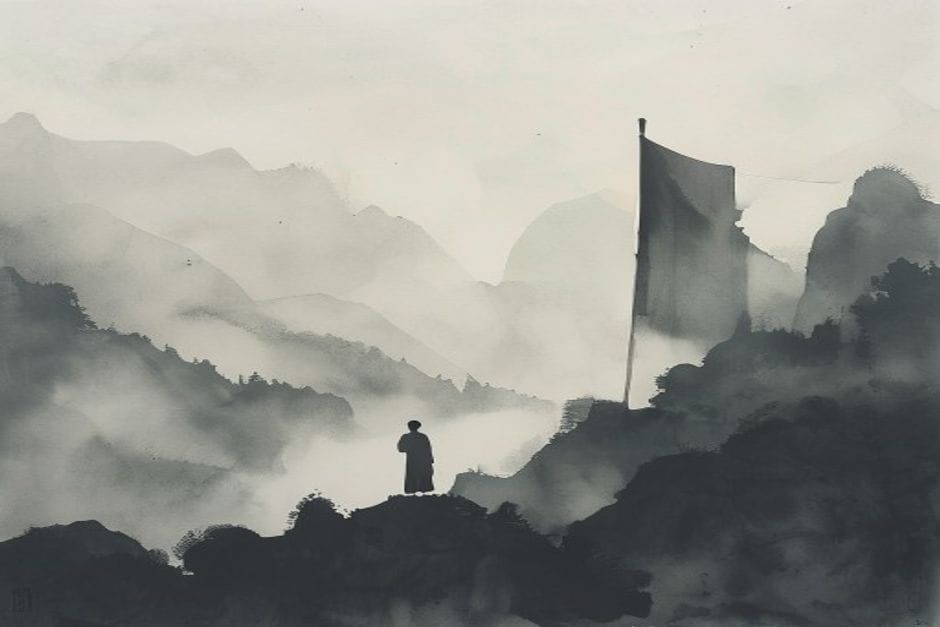
"Everything around me kept shifting — but the longer I stayed still inside, the more clearly I could see."
There is a particular kind of confusion that does not come from having too little information. It comes from having too much — too many voices, too many directions, too many compelling arguments for entirely contradictory paths. You are trying to build something meaningful with your life, your work, your creative expression — and the noise keeps rising. Someone tells you to niche down. Someone else tells you to expand. One month the consensus is that authenticity is everything; the next month the same crowd is chasing a trend you do not even understand. And underneath all of it, you are quietly asking: who am I supposed to be in this?
The fog is real. And pretending it is not there — white-knuckling your way through with false certainty — is not strength. But there is another way to move through unclear terrain. It is the way of the flag: not rigid, not unmovable, but planted deeply enough in something true that it does not blow away when the weather changes.
Sun Tzu understood fog better than almost any strategist in history. His most famous principle — 兵者詭道也, "the art of war is the art of deception" — is often read as a license for cunning and manipulation. But look more carefully, and something different emerges. The one who moves through fog successfully is not the one who pretends the fog is not there. It is the one who knows so clearly where they stand that they can adapt without losing themselves. Strategy requires adaptability. But adaptability without a center is just drift.
Fog in the ancient Chinese military sense was not merely weather. It was the fundamental condition of the battlefield: incomplete information, shifting circumstances, enemies who do not announce their intentions. Sun Tzu taught that the general who could operate well in fog was not the one who had eliminated uncertainty, but the one who had developed an interior compass reliable enough to navigate by. You adapt your tactics. You read the terrain. You respond to what is actually in front of you rather than clinging to a plan made in a different reality. But through all of that movement and responsiveness, your essential nature — your values, your judgment, your sense of what you are protecting — remains the flag that does not come down. Fog is the condition. Clarity within is the response.
(a) The Flag: The Self That Holds When Everything Else Shifts
兵者詭道也 is usually translated as "all warfare is based on deception," but a more complete reading might be: "strategy is rooted in responding honestly to complexity." The great strategist does not pretend conditions are simpler than they are. They see clearly — and then they move from that clarity, not from fear of the uncertainty.
Applied to the inner life, this principle asks a question that sounds simple but is rarely easy to answer: what are the things about you that should not change, regardless of what the external environment demands? Not your methods. Not your format. Not your platform or your schedule or even your language. But your values. Your particular way of seeing. The specific quality of attention you bring to the world. The things you find genuinely beautiful or genuinely troubling. These are the flag. Everything else — the tactics, the presentation, the iteration — is the strategy that can and should shift in response to the fog.
The problem that most people face is not that they lack adaptability. It is that they have never clearly distinguished between the flag and the tactics. So when someone tells them to change their style, they feel like they are being asked to change themselves. And when the market shifts, they do not know whether to follow it or hold their ground. Without that distinction, every external change becomes an identity crisis. With it, you can move with extraordinary flexibility — because you know exactly what you are being flexible around.
This is what authentic personal expression actually means. Not the performance of a fixed personality. Not refusing to grow or change. But having a center clear enough that your evolution has a direction — that each iteration of you is recognizably, distinctly, you.
(b) Why Clarity of Self Fades or Fails in the Fog
- You outsource your sense of direction to external feedback. Feedback is useful. Signals from the world — what resonates, what falls flat, what people respond to — are legitimate data. The trouble begins when that data stops informing your choices and starts making them. When every piece of criticism reshapes your direction, and every spike in engagement becomes a mandate, you are no longer navigating — you are being navigated. Over time, the cumulative effect of this is a kind of hollowing out. You become very good at producing what is wanted while forgetting what you actually want to say. The work becomes technically skilled but somehow lifeless, because the animating force behind it — your genuine perspective — has been smoothed away in the service of approval. What the fog reveals, in these cases, is that the flag was never planted deep enough to begin with.
- You confuse consistency with rigidity. Some people, reacting against the drift described above, decide that the answer is to never change anything — to hold a fixed identity as if it were a fortress. This, too, is a failure of navigation in fog. 兵者詭道也 does not counsel stubbornness. It counsels intelligence. A flag planted in the ground can wave freely in the wind — the movement is not instability, it is aliveness. If you refuse to adapt your methods, your presentation, your thinking in response to genuine new information, you are not honoring your values. You are using them as an excuse not to grow. The difference between principled consistency and defensive rigidity is whether your core values are genuinely guiding your evolution — or simply justifying your fear of it.
- You lose yourself in the performance of authenticity. There is, strangely, nothing more fog-inducing than the pressure to be authentic. When authenticity becomes a brand rather than a practice — something you perform for an audience rather than live for yourself — you end up in a peculiar trap. You are doing the right things: being vulnerable, being honest, showing the process. But somewhere in the performance, the original signal gets lost. You start asking not "what is true for me?" but "what kind of truthfulness do people find compelling?" When you are constantly watching yourself be authentic, you are no longer being it. When the flag is raised for the crowd — when "staying true to yourself" means always watching how that trueness lands — you have already drifted. Real clarity comes from the moments when no one is watching: what do you write in the notebook you will never share? That is the flag.
(c) Three-Step "Flag and Fog" Method: Ground → Distinguish → Adapt
- Ground — The first step is not about doing anything visible. It is about returning to what is actually true for you, underneath the noise. This requires silence — not necessarily literal silence, but a deliberate withdrawal from the feedback loop long enough to hear your own frequency again. Ask yourself: if no one was watching, if there were no metrics, if you had no audience to maintain — what would you still make? What would you still say? What problems would you still find worth thinking about? What kind of beauty would you still want to create? The answers to these questions, written honestly and revisited regularly, become the ground beneath the flag. They are not a program. They are a reference point — a way of knowing, when the fog thickens, which direction is still yours. "I started keeping a private document I called 'the real version' — one sentence a day about what I actually thought, with no concern for how it sounded. After a month, patterns emerged that surprised me. They were more coherent, and more strange, than anything I had been publishing."
- Distinguish — Once you have a sense of your ground, you can begin to sort the things that are changeable from the things that are not. This is active, ongoing work — not a one-time categorization, but a continuous practice of asking: is this feedback asking me to change my tactics, or my values? Is this trend something I can engage with honestly, or does engaging with it require me to pretend to be someone I am not? Is this evolution genuine growth, or is it drift? The distinction is not always clean, and that is fine. The practice of asking the question builds the muscle. Over time, you develop a felt sense — a quality of bodily recognition — for when something is asking you to adapt intelligently versus when it is asking you to disappear. "Someone suggested I should be more 'relatable' — and I sat with that for a week. Eventually I realized what bothered me: they were asking me to be less precise. Precision is not a tactic for me. It is how I think. So I changed the warmth, and kept the precision."
- Adapt — With the flag planted and the categories clear, adaptation becomes not a threat but a capacity. You can change formats, tones, approaches, platforms, styles — with genuine responsiveness to what the situation requires — because you know that none of these changes are touching what matters most. This is where Sun Tzu's fog strategy becomes liberating rather than destabilizing. The general who knows their own ground can move through any terrain. They are not attached to the plan made yesterday; they are responsive to the reality of today. And because their core judgment is intact, every adaptation serves the original purpose rather than replacing it. "I changed almost everything about how I wrote — shorter, more conversational, less theoretical. But the questions I was asking were the same questions I had always been asking. The fog changed the path. Not the destination."
(d) Four-Week "Inner Flag" Plan
| Week | Focus | Daily Practice |
|---|---|---|
| Week 1 | Grounding — identifying your actual values beneath the performed ones | 5-minute private writing: "If nothing I made was ever seen by anyone, I would still care about..." |
| Week 2 | Distinguishing — sorting tactics from identity in recent decisions | Review one recent change you made in response to feedback: was it tactical or essential? |
| Week 3 | Testing adaptation — make one deliberate change to form while holding content constant | Try a new format, tone, or medium for one piece while keeping your core question or perspective unchanged |
| Week 4 | Integration — noticing when you feel most like yourself in your work | At day's end, note one moment when your work felt truest — not most successful, but most you |
By the end of four weeks, you will not have eliminated the fog. The fog does not go away — that is not the goal, and anyone who promises to clear it entirely is selling something. What you will have developed is something more durable than clarity about the terrain: clarity about yourself within it. You will have a sharper sense of which questions are worth asking, which changes are worth making, and which discomforts are signals to pay attention to versus weather to walk through.
The fog, in this sense, is not the enemy of authentic expression. It is its teacher. Every time the external conditions shift dramatically — every trend cycle, every platform change, every new consensus about what good work looks like — you are given an opportunity to discover what you will and will not move on. The flag that has never been tested in wind is just a decoration. The one that has bent in every storm and returned to upright is the real thing.
Self-connection Mini Practice
- Recall a time when you changed something about yourself or your work in response to external pressure — and later felt that you had lost something important in the process. What was the thing that got lost? Did you ever recover it, and if so, how?
- Right now, in your work or creative life, what feels like fog — genuinely uncertain, hard to read, with no clear right answer? And within that fog, what is the one thing you are most sure of — the flag that has not moved even as everything else has shifted?
- This week: identify one place where you have been adapting in a way that might actually be drifting. Not to judge it — just to name it honestly. What would it look like to make that same adaptation while keeping the flag planted?
The ancient strategist understood something that gets lost in the noise of modern self-building: you do not need to see the whole field to move well. You need to know your own ground. When you know where you are standing — truly, not just theoretically — every step into the fog becomes navigable. Not easy. Not certain. But navigable, because you have the one reference point that cannot be taken from you: the knowledge of who you are when no one is telling you who to be.
The fog will come and go. Trends will rise and disappear. What people want from you will shift with the season. But the flag you plant deep in honest self-knowledge — that is the thing that will still be standing when the morning clears. And it is the thing that others, lost in their own fog, will eventually be able to navigate by.
Plant the flag. Stay with what is true. Move through the fog as yourself.
If you're open to more reflections and ancient wisdom on knowing yourself and moving through uncertainty: 👉 Tap here to explore more about identity & resilience. When you stop asking who you should become — you don't just find direction — you become someone others can trust to hold a light in the dark.
Frequently Asked Questions
What does Sun Tzu's principle 兵者詭道也 really mean for personal identity?
Usually translated as "all warfare is based on deception," a richer reading is "strategy is rooted in responding honestly to complexity." Applied to personal identity, it means the goal is not to eliminate uncertainty but to develop a clear inner compass. You do not need to know everything about your path — you need to know what you stand for. When your core values are clearly distinguished from your tactics and methods, every external shift becomes navigable: you can adapt strategies freely precisely because you know which parts of yourself are not for adapting.
How do I tell the difference between adapting wisely and drifting away from myself?
The key question is: is this change touching your tactics, or your values? Tactics are the how — your format, platform, tone, schedule, presentation style. Values are the what and why — your way of seeing, the questions you care about, what you find genuinely beautiful or troubling. When feedback asks you to change a tactic, adaptation is healthy. When it asks you to stop seeing in the way that is distinctly yours, that is drift. Practice asking the question regularly; over time you develop a felt sense — a bodily recognition — for the difference between intelligent adaptation and quiet self-erasure.
Why does performing authenticity actually make it harder to stay true to yourself?
When authenticity becomes a brand — something performed for an audience rather than lived for yourself — a subtle shift occurs. You stop asking "what is true for me?" and start asking "what kind of truthfulness do people find compelling?" The original signal gets replaced by a curated version of it. Real clarity comes from the moments when no one is watching: what you write in the notebook you'll never share, what you make when there are no metrics attached. That private signal is the flag. The performance of authenticity is a copy of it, and copies drift over time toward what the audience wants, not what is actually true.
Is it possible to be too consistent — to hold the "flag" too rigidly?
Yes. Principled consistency and defensive rigidity look similar from the outside but feel very different from the inside. A flag planted in the ground can wave freely — the movement is aliveness, not instability. If you refuse to adapt your methods, thinking, or presentation in response to genuine new information, you are not honoring your values; you are using them as an excuse not to grow. The test is whether your core values are genuinely guiding your evolution or simply justifying your fear of change. Real consistency means the direction of growth stays recognizably yours — not that nothing ever changes.
What is the simplest daily practice for maintaining inner clarity in uncertain times?
Keep a short private writing practice — even one sentence a day — where you record what you actually think, with no concern for how it sounds or who might read it. This is your "real version" document, separate from anything you publish or share. Review it periodically and look for patterns. Over time, this practice creates a reference point: when the fog of trends, feedback, and external pressure thickens, you have something to return to. It tells you not what to do, but who you are — which is the one piece of navigation that cannot be taken from you.