The Wisdom of Water — Winning Without Force
"I have learned that the most lasting victories in my life were never the ones I forced — they were the ones I allowed to become inevitable."
Sun Tzu wrote one of the most counterintuitive lines in all of military history: the supreme art of war is to subdue the enemy without fighting. For two thousand years, generals and strategists have puzzled over that sentence — and most of us, in our own lives, keep missing its deeper meaning. We equate effort with progress. We confuse hustle with achievement. We believe that more force produces more results, and when something doesn't move, we push harder. This article explores three ideas that challenge that belief: why the most effective path to a goal is often not through it but around it; why the drive to force outcomes quietly exhausts us and produces brittleness where we need resilience; and how a Water Method — drawn from the Art of War's own image of flowing water — can help you accomplish more by straining less, building systems that do the work even when you are not pushing.
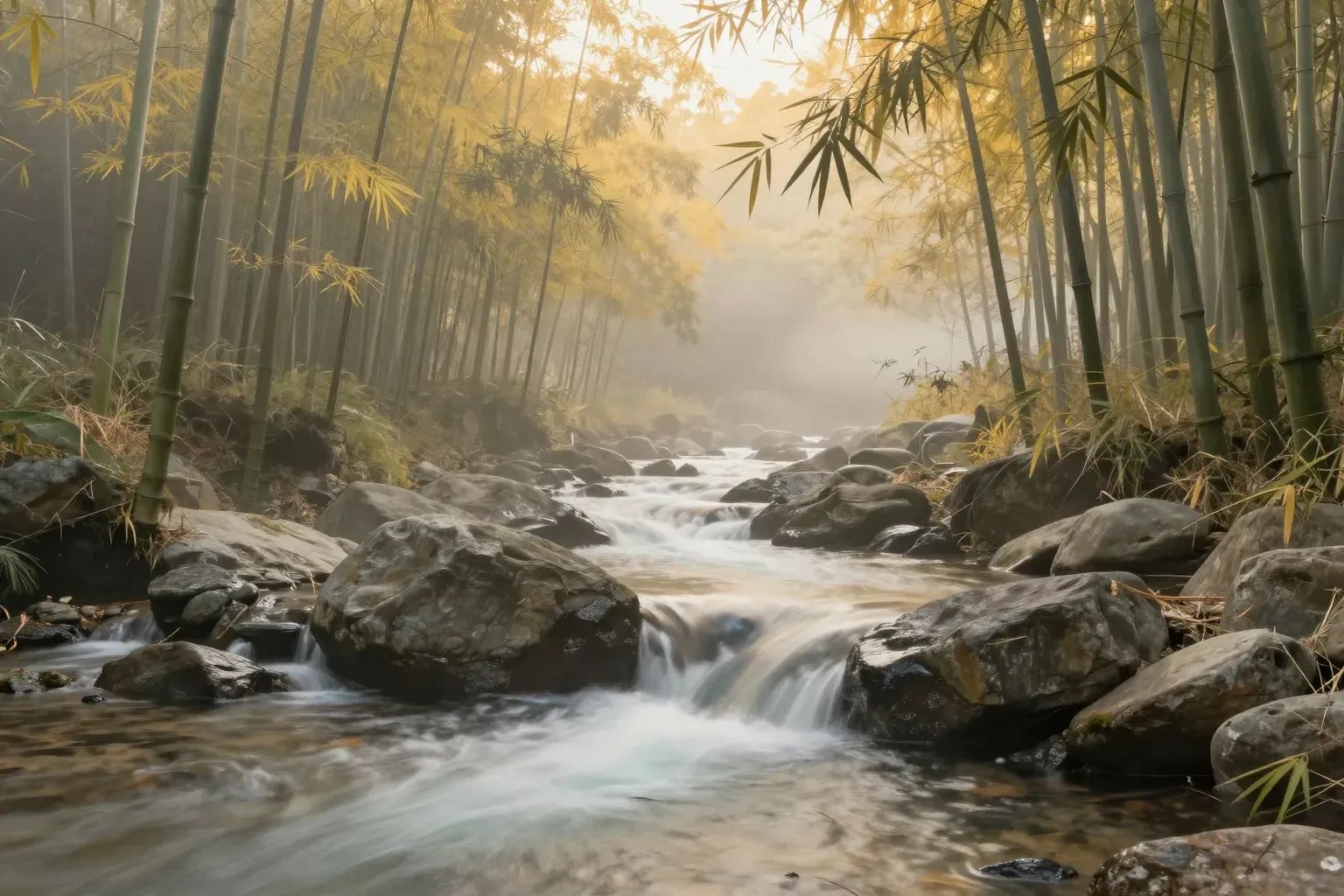
Picture a mountain stream in early spring. The snow is melting high above, and somewhere up in the rocks a trickle begins. It does not know where it is going, exactly. It has no plan. But it has an orientation: downward, always. It meets a boulder — and it does not stop to fight the boulder. It curls around it. It meets a shallow depression and fills it completely before moving on. It joins with other trickles, and without any single decision or burst of effort, it becomes a river. Months later, the same water that could not have moved that mountain boulder has carved a canyon. It did not use force. It used time, consistency, and the willingness to follow the path of least resistance without ever losing its essential direction. This is not laziness. This is not passivity. This is what Sun Tzu meant — and it is one of the most powerful orientations you can bring to your own work and life.
(a) Water: The Shape That Cannot Be Defeated
In the Art of War, the image of water appears more than once — but never more vividly than in this passage: 軍形象水, "the shape of an army should be like water." Water takes the shape of whatever contains it. It does not insist on a particular form. It finds the low places, the gaps, the paths that are already open. And yet, given enough time, water accomplishes what no fixed force can: it reshapes stone. It carves valleys. It delivers life to deserts.
The concept of 不戰而屈人之兵 — winning without fighting, subduing without collision — is not about being weak. It is about understanding leverage. It is about recognising that the most durable outcomes in life rarely come from frontal assault. They come from positioning: placing yourself and your effort so well that resistance becomes unnecessary. A skilled negotiator does not overpower the other party — they create conditions in which agreement becomes the other party's own idea. A writer who builds a small, loyal audience does not fight for attention — they have established a relationship so genuinely useful that readers return without being pushed. A person who has designed their environment to make good habits easy does not fight their own impulses every morning — they have made the desired behaviour the path of least resistance.
This is what the water image teaches: before you ask how hard to push, ask whether you are pushing in the right direction — and whether you need to push at all. Sometimes the greatest act of intelligence is to stop fighting the shape of things and start flowing through the opening that already exists. Effort spent fighting resistance head-on is effort not spent finding the way around. And around, in the long run, is almost always faster.
(b) Why Winning Without Force Fades or Fails
- We have been taught that struggle signals seriousness. There is a deep cultural story in many traditions — particularly in the modern West — that equates difficulty with virtue. If something is not hard, we suspect it is not legitimate. If we are not exhausted, we feel we haven't earned the result. This belief is not entirely wrong: meaningful things do require real investment. But it becomes a trap when we start choosing the hard path because it feels more morally satisfying, even when an easier path exists. We work in ways that demonstrate effort rather than in ways that produce results. We mistake visible straining for actual progress. Water never makes this mistake. It does not choose the harder route to prove a point. It simply goes where it can go — and gets there.
- Systemic thinking feels abstract while urgent action feels real. The water approach is fundamentally a systems approach: build structures, relationships, and habits that compound quietly over time, so that each day's small contribution flows into the next. But systems take time to become visible, while the dopamine of direct action is immediate. Sending twenty emails feels productive in a way that writing one excellent newsletter does not. Attending three networking events feels busy in a way that maintaining two deep professional relationships does not. We reach for direct action not because it is more effective but because the feedback loop is faster. Meanwhile, the slow accretion of a well-designed system — like water finding its channel — goes unnoticed until one day it is simply the landscape.
- We have not learned to distinguish force from flow. Not all effort is force. Not all ease is laziness. This distinction is genuinely difficult because the surface appearance can be identical: someone working twelve-hour days might be in deep creative flow, while someone working four hours might be grinding against every hour in a direction that was never right for them. The difference is internal — it is the quality of resistance you encounter. Force feels like pushing a door that opens inward. Flow feels like finding that the door was never locked. When the work consistently costs more energy than it produces, that is information. When the work consistently generates more momentum than the effort invested — that is water finding its channel. When you force, everything is a battle. When you flow, the terrain begins to cooperate.
(c) Three-Step "Water Method": Observe → Channel → Compound
- Observe — Before deciding where to direct your energy, spend time studying the actual landscape of your situation. What already has momentum? What moves easily when you touch it, and what drags no matter how hard you push? Sun Tzu was meticulous about reconnaissance — not to appear decisive, but because right action depends entirely on accurate perception. In your own life, this means noticing the difference between goals you are forcing and goals you are flowing toward. It means asking honestly: which of my current efforts feel like water finding its channel, and which feel like water climbing a hill? The observe step is not passive — it is an active, disciplined form of attention. It requires you to detach from the story of what you think you should be doing and look clearly at what is actually happening. "I spent three weeks trying to grow on one platform. Nothing moved. Then I wrote a single piece somewhere else and it spread on its own in two days. I stayed still long enough to notice the difference."
- Channel — Once you have seen where energy naturally flows, your job is to shape and direct that flow — not create it from scratch. A channel does not generate water; it concentrates and guides what is already moving. This is the leverage principle in its purest form: instead of generating effort from zero, you ask what small structural change would cause existing momentum to compound. It might be automating a repetitive task so your attention is freed for the work that actually requires you. It might be publishing at the time and in the format where your audience already gathers, instead of the time and format you prefer. It might be building one deep relationship with someone whose work aligns with yours, instead of spreading attention across dozens of shallow connections. The channel step asks: what is the smallest intervention that would allow the most flow? Not the grandest plan — the smallest lever that unlocks the most movement. "Instead of writing more, I built a simple template for the writing I already did well. The output doubled. The effort halved."
- Compound — Water's power is not in any single moment of flow. It is in accumulation. The canyon is not carved by one flood — it is shaped by ten thousand quiet days of water meeting stone. The compound step is where most people give up, because compounding is invisible until suddenly it is overwhelming. It requires a particular kind of faith: not blind optimism, but the studied confidence of someone who has observed a system working and trusts the mathematics of accumulation. Practically, this means designing your effort so that today's work makes tomorrow's work easier. Every piece of writing that exists makes the next piece easier to place. Every relationship maintained makes the next introduction easier to make. Every skill practiced makes the adjacent skill faster to learn. Compounding is water's secret — and it is available to anyone willing to stay consistent long enough for the canyon to begin. "I kept the same small practice for eight months and nothing visible happened. Then, in the ninth month, three things opened at once. The water had been carving all along."
(d) Four-Week "Water Way" Plan
| Week | Focus | Daily Practice |
|---|---|---|
| Week 1 | Reconnaissance — map the landscape | Each evening, write two sentences: one thing that moved with surprising ease today, and one thing that resisted no matter how much effort you gave it. At the end of the week, look for patterns. |
| Week 2 | Release — stop fighting one thing | Identify the single effort that has cost the most energy with the least return. Deliberately pause it this week. Notice what the freed attention wants to move toward instead. |
| Week 3 | Channel — build one small system | Choose the area of your work or life with the most natural momentum and build one tiny structural support for it: a template, a scheduled time, a standing arrangement. Do it once and let it run. |
| Week 4 | Compound — commit to the long flow | Choose one practice from weeks 1–3 that produced genuine ease and commit to it for ninety days. Write the commitment down in one sentence. Tell one person who will notice if you stop. |
The four weeks above are not a programme to complete and then set aside. They are an introduction to a way of moving through your own life — one that you will return to, refine, and deepen over years. What tends to happen for people who genuinely practice the water approach is not a dramatic revolution in a week. It is something quieter and more durable: a gradual reduction in the grinding friction that characterised so much of their effort before. Goals that once required daily willpower begin to happen almost on their own. Relationships that required constant maintenance begin to sustain themselves. Work that felt like pushing boulders begins to feel like choosing the right direction and letting gravity assist. This is not magic. It is the natural result of aligning your effort with the structure of the situation rather than against it.
Self-connection Mini Practice
- Think of a goal you reached in your life that felt surprisingly smooth — where the path seemed to open rather than require forcing. What was different about how you approached it? What conditions allowed it to flow?
- Look at the landscape of your current efforts. Where is water flowing freely — and where are you carrying buckets uphill? What would it feel like to set the buckets down?
- Choose one area of your life this week where you will stop pushing and instead spend three days observing. What does the terrain actually want to do? What moves on its own when you stop interfering?
The most surprising thing about the water wisdom is not that it works — it is that it works especially well in the places where nothing else has. The goals we chase most desperately, the relationships we grip most tightly, the ambitions we attack most aggressively — these are often exactly the situations where the water approach produces the most dramatic shift. Not because effortlessness is always available, but because the right kind of effort — patient, directional, structurally intelligent — is almost always more powerful than brute force. Sun Tzu understood this not as a spiritual principle but as a military reality: the general who wins without fighting has understood the situation so completely that fighting was never necessary. In your own life, that kind of understanding begins with one question, asked honestly, again and again: where is the channel that already exists — and am I brave enough to flow into it?
If you're open to more reflections, symbols, and ancient wisdom that quietly reshape the way you move through life: 👉 Tap here to explore more about leverage & ease. When you stop fighting the shape of things — you don't just reduce effort — you discover what you were always capable of.
Frequently Asked Questions
What does "winning without fighting" actually mean in everyday life?
It means designing your effort so that resistance naturally dissolves rather than trying to overpower it. In practice, this looks like: positioning a conversation so the other person arrives at agreement on their own; building habits into an environment so you don't fight yourself each morning; creating work that serves a genuine need rather than demanding attention. The goal is not to be passive — it is to be so strategically positioned that the outcome becomes nearly inevitable without requiring brute force to produce it.
How do I know if I'm using force or flow in my work?
The key indicator is the quality of resistance you consistently encounter. Force feels like pushing a door that opens inward — the harder you push, the more it resists. Flow feels like discovering the door was never locked. If a particular effort consistently costs more energy than it produces — if you end each session more depleted than when you began, with little visible progress — that is information. When effort generates more momentum than it consumes, you have found water's channel. Tracking both the effort invested and the movement produced over two to three weeks will usually reveal the pattern clearly.
Is the Water Method just about avoiding hard work?
Not at all — it is about choosing which hard work is worth doing. The Water Method distinguishes between effort that strains against the structure of a situation and effort that works with it. Water does not take the easy path in the sense of avoiding effort; it takes the path that the terrain has already opened. This can still require enormous sustained effort — carving a canyon is not effortless — but the effort is directional and compounding rather than wasted against immovable resistance. The question is never "how hard" but "in which direction."
Why does compounding feel invisible for so long before it becomes powerful?
Because compounding is exponential, and exponential growth is flat until it suddenly isn't. The first eight months of a small consistent practice produce changes too incremental to notice. The ninth month, when the accumulation crosses a threshold, can feel like a sudden explosion — but the canyon was being carved all along. This is why most people give up just before the compounding becomes visible: the feedback loop is too slow for our pattern-recognition to confirm that the effort is working. Tracking leading indicators — small daily inputs — rather than waiting for lagging outcomes helps bridge this gap.
What is the first concrete step to take if I want to try the Water Method this week?
Begin with the Observe step: for seven days, at the end of each day, write one sentence about something that moved with surprising ease, and one sentence about something that resisted regardless of effort. At the end of the week, read back through all fourteen sentences. You will almost always see a pattern — a few areas of genuine flow and a few areas of consistent friction. That map is your starting point. The Water Method begins not with a decision about where to go, but with honest attention to where the current already exists.