The Arrow's Path - The Power of Focused Sprints Over Endless Effort
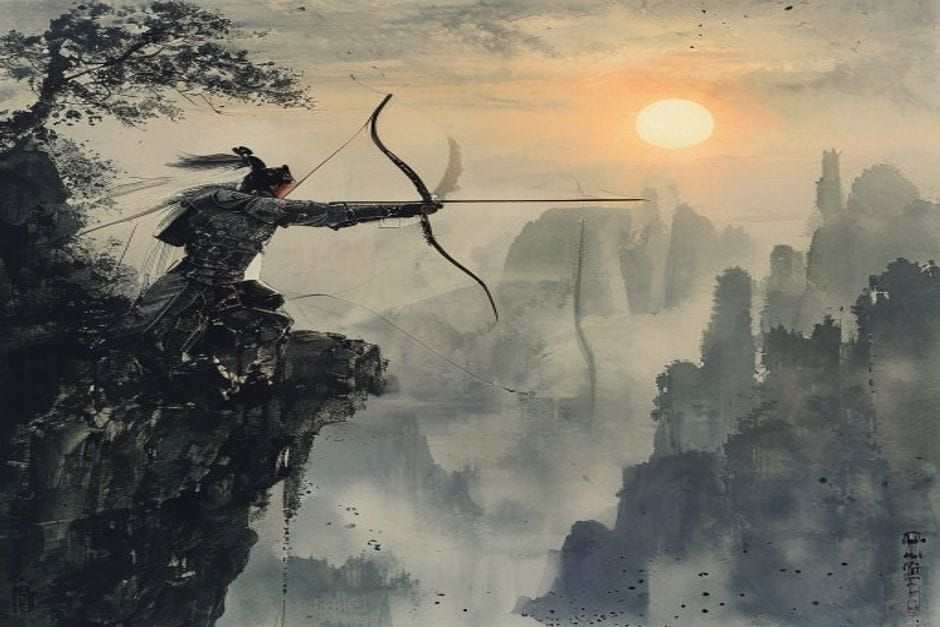
"I have learned that the most powerful thing I can do is not work longer — it is to aim once, clearly, and release."
There is a particular kind of exhaustion that has nothing to do with how hard you worked. It is the exhaustion of someone who never quite stopped. The person who answered emails at midnight, revised the same document for the fourth time, added one more task to a list that somehow never shortens. You know this feeling. You might be living it right now — not burned out from effort exactly, but worn thin by the relentless, low-grade hum of always being in motion without ever feeling like you truly arrived anywhere.
We have been taught, many of us, that persistence is the highest virtue. That showing up every day, grinding through resistance, refusing to quit — these are the marks of someone serious about their goals. And there is truth in that teaching. But it is an incomplete truth, and the missing half is costing people their clarity, their health, and eventually, their drive.
Sun Tzu understood something about energy that most productivity advice still misses. Writing in the fifth century BCE, this Chinese military strategist described victory not as something you grind toward, but as something you release — quickly, decisively, from a position of total readiness. His principle, 兵貴勝不貴久 (bīng guì shèng bù guì jiǔ), translates roughly as: "In war, what matters is victory, not prolonged campaigns." The arrow does not hesitate. It does not circle. It does not try harder by flying slower. It simply travels the shortest path between where it is and where it needs to go — and then it stops.
What does an ancient military text have to teach someone sitting in a coffee shop trying to finish a creative project, or a parent trying to carve out one hour of meaningful work between school pickups and dinner preparation? More than you might expect. Because the core insight — that focused, contained bursts of effort outperform drawn-out, diffuse labor — has been confirmed again and again in modern research on human performance, cognitive science, and creative output. The ancient archer and the modern knowledge worker face the same essential problem: limited energy, a target worth hitting, and the question of how best to spend what they have.
The problem is rarely that we lack effort. The problem is that we never draw the bow all the way back. We are always mid-pull — never fully invested in rest, never fully invested in work, perpetually suspended between the two. The arrow of our attention scatters. We try to sustain momentum across sixteen hours of half-concentration rather than pouring ourselves into four hours of complete focus. And the tragedy is that the sixteen-hour approach often produces less — less quality, less satisfaction, less genuine progress — than the four-hour approach would have.
(a) The Arrow: What a Focused Sprint Actually Means
The symbol of the arrow is not accidental here. An arrow works because every element of its design serves a single purpose. The shaft is straight so energy travels without waste. The fletching stabilizes the flight path. The arrowhead concentrates all that accumulated force into one precise point. There is no room in an arrow for ambiguity about direction.
A focused sprint — what some call a deep work session — works the same way. It is a defined window of time, typically between sixty and one hundred twenty minutes, during which you give a single task your complete, undivided attention. No checking messages. No switching between tabs. No allowing your mind to drift toward what you need to do after. Just the one thing, for the one window, with everything you have.
This is what 兵貴勝不貴久 points toward: not just speed, but totality of commitment within a bounded frame. Sun Tzu was not advising recklessness. He was advising against the slow drain of prolonged campaigns — the way extended effort depletes resources, lowers morale, and allows the enemy (or in our case, distraction, doubt, and fatigue) to regroup and strengthen. A swift, well-prepared strike is not hasty. It is the culmination of preparation, executed without hesitation once the conditions are right.
When you sit down for a focused sprint, you are not rushing. You are releasing. The preparation happened before you sat down — you know what the task is, you have cleared the space, you have set the timer. Now all that remains is the flight. And in that flight, something remarkable tends to happen: you find a quality of thinking, a fluency of work, that is simply not available to the scattered, multitasking mind. Psychologist Mihaly Csikszentmihalyi called this state flow — the experience of being so absorbed in a meaningful challenge that time seems to bend, self-consciousness fades, and the work itself carries you forward.
(b) Why Prolonged Effort Fades or Fails
- It mistakes motion for progress. When we work without clear boundaries, we often fill the available time rather than completing the actual work. A task that should take ninety minutes expands to fill an entire afternoon — not because the work required it, but because we never told ourselves it was allowed to end. This is Parkinson's Law in practice: work expands to fill the time allotted for its completion. The result is a strange paradox where working more produces less. You spend four hours on something you could have finished in one and a half, but the extra time was not spent thinking more deeply — it was spent hovering, fussing, second-guessing, losing the thread. The motion was continuous. The progress was not.
- It depletes the resource it depends on. Focused cognitive work draws on a finite reservoir of mental energy. Neuroscience research consistently shows that sustained attention degrades over time — what researchers sometimes call "decision fatigue" or "ego depletion." The longer you work without genuine rest, the less capable your brain becomes of doing the kind of work that actually matters: generating novel ideas, evaluating complex information, making sound judgments. When we work all day without structured breaks, we are not working for twelve hours — we are working for perhaps three hours and pretending for nine. The pretending is exhausting, and it produces the worst possible output: mediocre work done slowly by a tired mind that feels guilty for being tired.
- It confuses endurance with depth. When you never stop, you never fully start. When there is no end to your working day, there is also no beginning — no clean threshold you cross where you become fully present. Compare this with the experience of a musician preparing for a performance: the rehearsal has an end time. The concert has a curtain call. Because the musician knows when the work stops, she can throw herself into it completely while it lasts. The sprint worker knows the same thing: this window closes in ninety minutes. So there is no holding back, no pacing yourself for an imaginary marathon that lasts the rest of your life. You give what you have. Then you rest. Then you give again.
(c) Three-Step "Arrow Method": Draw → Aim → Release
- Draw (Prepare before you begin) — The arrow does not leave the bow until the archer has fully drawn. In the same way, a focused sprint only works if the preparation happens outside the sprint itself. This means deciding, before you sit down, exactly what you will work on. Not "I'll work on the project" but "I will write the opening section of the report, from the blank page to a complete first draft of three paragraphs." The specificity matters enormously. Vague intentions produce vague effort. Before your sprint begins, clear your space, silence your notifications, fill your water glass, use the bathroom, and answer the small urgent questions that would otherwise ambush your concentration fifteen minutes in. The draw phase is your readiness ritual — and its length should be proportional to the sprint itself. A ninety-minute session might be worth ten minutes of preparation. Think of it as the archer's slow breath before the pull: not wasted time, but time that makes everything that follows more precise. "Before I write," one novelist describes it, "I make tea, I stand at the window for three minutes, and I read the last paragraph I wrote the day before. By the time I sit down, I am already inside the story."
- Aim (Set a single clear target) — The arrow does not try to hit multiple targets at once. This sounds obvious, but most of us violate it constantly. We open the document and also check the inbox and also have a podcast playing and also leave the messaging app visible, just in case. Each of these is a second target — a competing claim on your attention that slightly deflects the arrow's path. The result is not efficiency through multitasking; it is diffusion of effort through fragmented attention. For your sprint, there is one target. One task. One output that does not exist before you begin and will exist when you end. Write it down if it helps: a single sentence describing exactly what you are making or solving in this window. Then close every other tab. Put your phone in another room if necessary. You are not being rigid — you are being an archer. "The moment I named the one thing I was doing," a product designer once shared, "I stopped feeling overwhelmed. There was just the one thing and me. Everything else could wait."
- Release (Work without reservation, then stop completely) — The third step is the hardest, and it has two parts that are equally important: working without holding back, and stopping when the time is up — even if you feel like you could keep going. The first part — full commitment during the sprint — follows naturally from the draw and aim phases if you have done them well. You have prepared. You know your target. Now you simply fly. Do not edit as you go. Do not pause to check whether it is good. Do not allow the inner critic to redirect the arrow mid-flight. Trust that the preparation was enough, and let the work happen. The second part — stopping completely — is what most people resist, because stopping feels like quitting. But it is the opposite. When you stop fully, you allow your brain to process, consolidate, and recover. The insights that arrive in the shower after a deep work session are not accidents; they are the result of releasing the bow. "I set a timer," writes one engineer, "and when it goes off, I save the file and close the laptop, even mid-sentence. The next morning, I always know exactly what the next sentence is."
(d) Four-Week "Arrow Training" Plan
| Week | Focus | Daily Practice |
|---|---|---|
| Week 1 | Build the habit of starting | One 45-minute sprint per day. No pressure on output — just the practice of sitting down, choosing one thing, and giving it your full attention until the timer ends. |
| Week 2 | Lengthen and deepen | Extend to one 75-minute sprint. Add a 5-minute preparation ritual before the sprint begins. Notice what preparation steps make the biggest difference to your focus quality. |
| Week 3 | Add a second sprint | Two 75-minute sprints per day, with at least 30 minutes of genuine rest between them. Rest means away from screens and work — a walk, a meal, quiet reading. |
| Week 4 | Optimize your arrow | Choose your best two sprint windows based on three weeks of data (when were you sharpest?). Protect those windows as non-negotiable. Begin scheduling around your sprints rather than fitting sprints into your schedule. |
By the end of four weeks, you will likely notice something surprising: you are producing more of what actually matters — more finished work, more coherent thinking, more creative breakthroughs — in fewer hours than you were before. This is not a trick or a life hack. It is what happens when you stop treating your attention as an infinite resource and start treating it as the precious, finite, renewable thing it actually is. You cannot sustain an arrow in flight indefinitely. But you can nock another arrow. And another. Each one clear, each one aimed, each one released with full commitment. This is how the archer becomes skilled. Not by shooting all day, but by shooting well, resting, and shooting again.
Self-connection Mini Practice
- Think about the last time you felt genuinely absorbed in a piece of work — where time moved strangely and the effort felt almost effortless. What were the conditions that made that possible? Can you recreate any of them intentionally?
- What is one task you have been "always working on" without it ever quite getting finished? What would a single, bounded, complete sprint toward that task look like — with a start, an end, and one clear deliverable?
- When your work ends each day, does it actually end? Or does it blur into your evenings, your weekends, the edges of your sleep? What would it feel like to draw a clean line and say: the arrow has landed. I will fly again tomorrow.
The bow does not apologize for not staying bent. The arrow does not feel guilty for landing. These are the natural rhythms of things designed to do one thing well: gather, release, arrive. You were not built to be perpetually mid-effort. You were built to concentrate completely, give fully, and then — with equal wholeness — rest. The ancient strategist who wrote those words two and a half thousand years ago was not talking only about armies. He was describing a truth about energy itself: that what matters is the quality of the strike, not the length of the battle. You do not need more hours. You need one clear target, one fully drawn bow, and the courage to let the arrow fly. That is enough. That has always been enough.
If you're open to more reflections and ancient wisdom on focus and intentional living: 👉 Tap here to explore more about depth & direction. When you protect your attention — you don't just work better — you live more fully.
Frequently Asked Questions
What is a focused sprint and how long should it be?
A focused sprint — also called a deep work session — is a defined window of time during which you give a single task your complete, undivided attention with no interruptions. Research on cognitive performance suggests the optimal length is between 60 and 120 minutes. Shorter than 60 minutes rarely allows the full depth of concentration to develop; longer than 120 minutes tends to degrade attention quality significantly. Start with 45 minutes if you are new to the practice, and gradually extend to 75 or 90 minutes as the habit solidifies. The key is having a hard stop — knowing in advance when the sprint ends — which is what allows genuine full commitment during it.
How do I handle urgent interruptions during a sprint?
The goal before every sprint is to eliminate predictable interruptions before they happen: silence notifications, close unnecessary tabs, tell people around you that you're unavailable for the sprint window, and address any small urgent matters during the Draw phase of preparation. For genuinely unexpected emergencies, stop and handle them — no method is more important than a real crisis. But most "urgent" interruptions during deep work are not actually emergencies; they are habituations to constant availability. With practice, you will get better at distinguishing genuine urgency from the anxiety of disconnection. A useful test: if it can wait 90 minutes, let it wait.
I often feel guilty stopping when time is up, even mid-task. How do I overcome this?
This guilt is actually a sign the method is working — it means you're genuinely invested in the work. The reframe that helps most people is understanding that stopping completely is itself part of the work, not a break from it. Your brain continues processing during rest; many significant insights arrive in the hours after a deep work session, not during it. When you stop mid-sentence or mid-problem, you give your subconscious a specific problem to work on overnight. Most people who practice this find that when they return the next day, they know exactly where to pick up. The sprint isn't abandoned — it's extended into recovery, which is where a large part of the real work happens.
Is this approach compatible with jobs that require constant communication and availability?
Yes, but it requires intentional negotiation of your time. Most roles that seem to require constant availability actually require responsiveness within a reasonable window — often 30–60 minutes is perfectly acceptable. The key is to communicate clearly: set a status, block your calendar, and batch your communication into dedicated windows rather than responding continuously. Two or three focused sprints per day with clear communication windows between them often produces more visible output than a full day of reactive, always-available work. Many people find that colleagues and managers are more impressed by consistent delivery than by instantaneous response.
What is the connection between the arrow metaphor and Sun Tzu's 兵貴勝不貴久?
Sun Tzu's principle — that in warfare, what matters is swift decisive victory, not prolonged campaigns — maps directly onto how an arrow works. An arrow does not circle the target, hesitate, or try to reach it through sustained sustained hovering. It commits fully to a single trajectory from a position of total readiness and then arrives. The arrow metaphor illuminates what Sun Tzu's principle means for human effort: the quality and decisiveness of the strike matters far more than the duration of the effort. An extended, diffuse campaign depletes resources and allows resistance to regroup — just as a scattered, all-day approach to work depletes attention and allows distraction to accumulate. The arrow teaches us to concentrate force, release completely, and then prepare for the next shot.